Last updated October 30, 2026
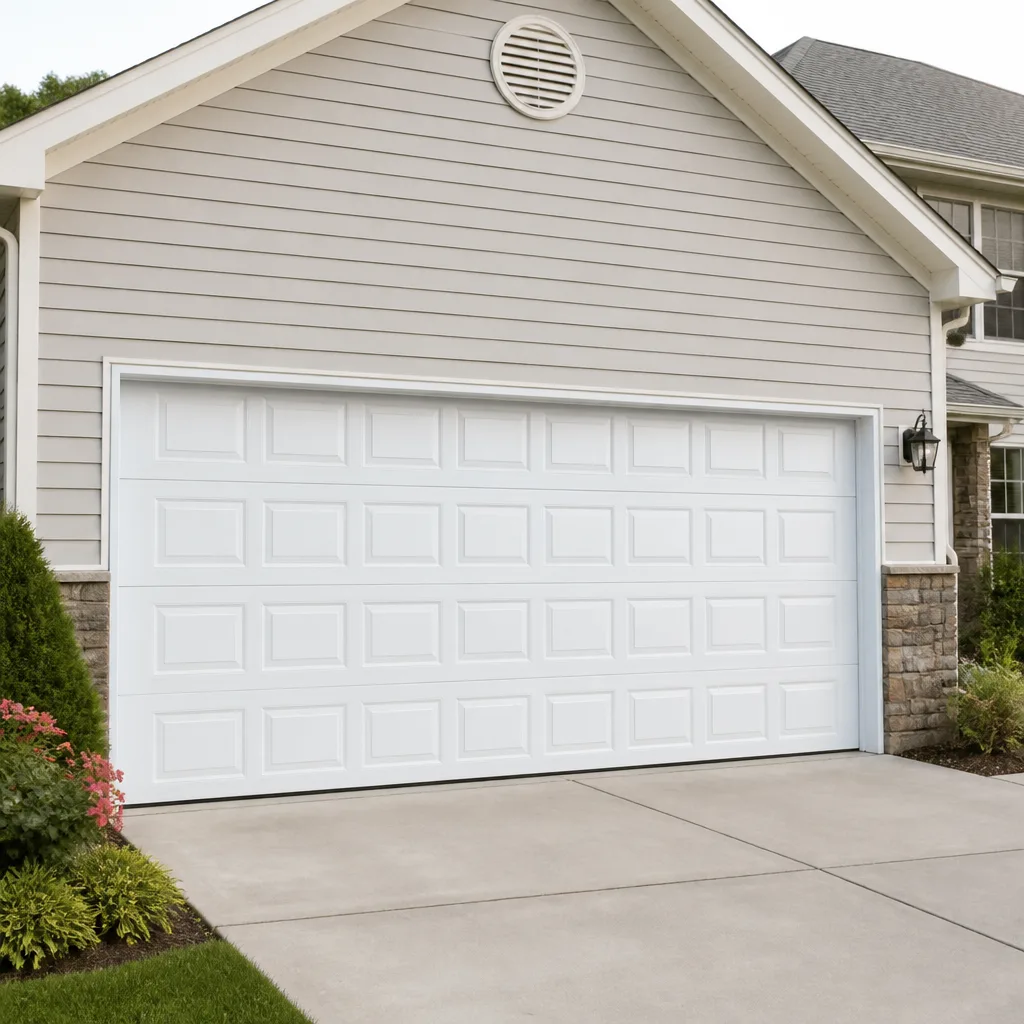 Raised-panel steel
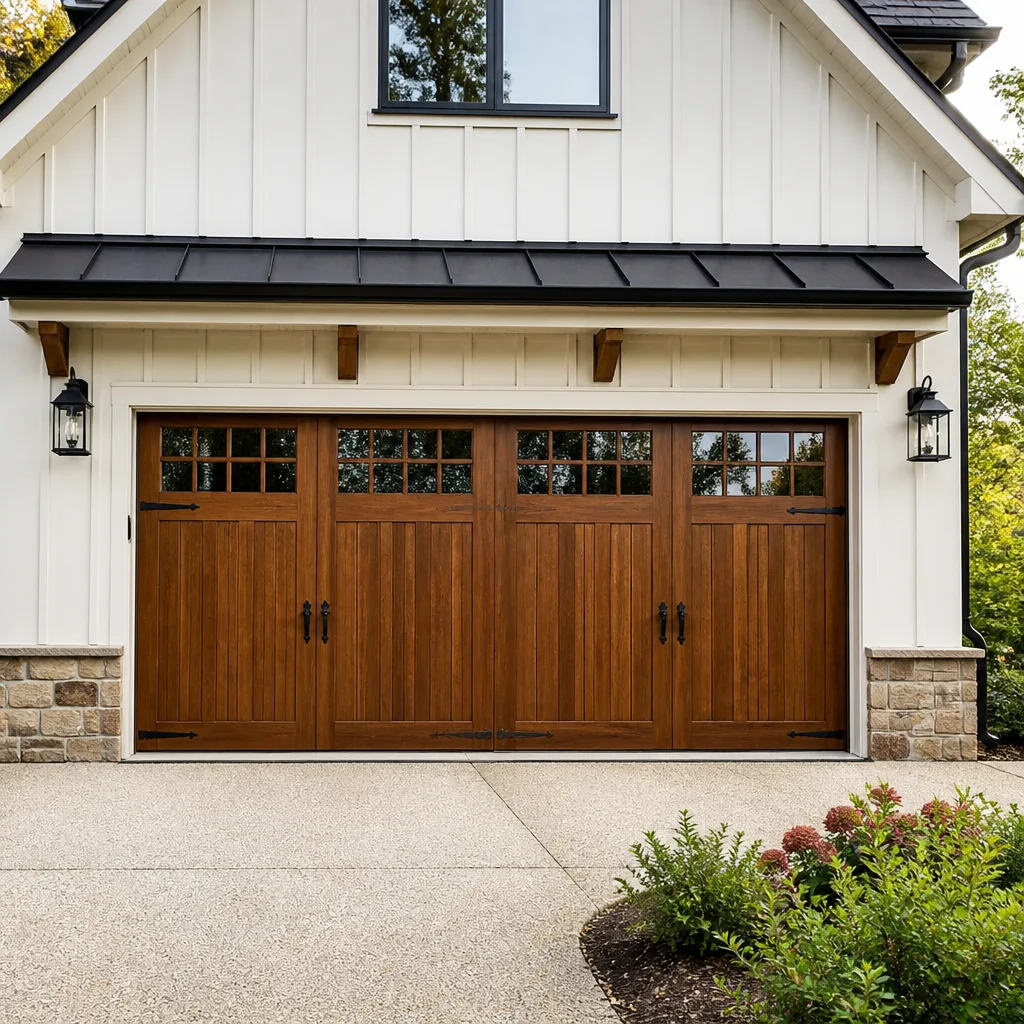 Carriage house
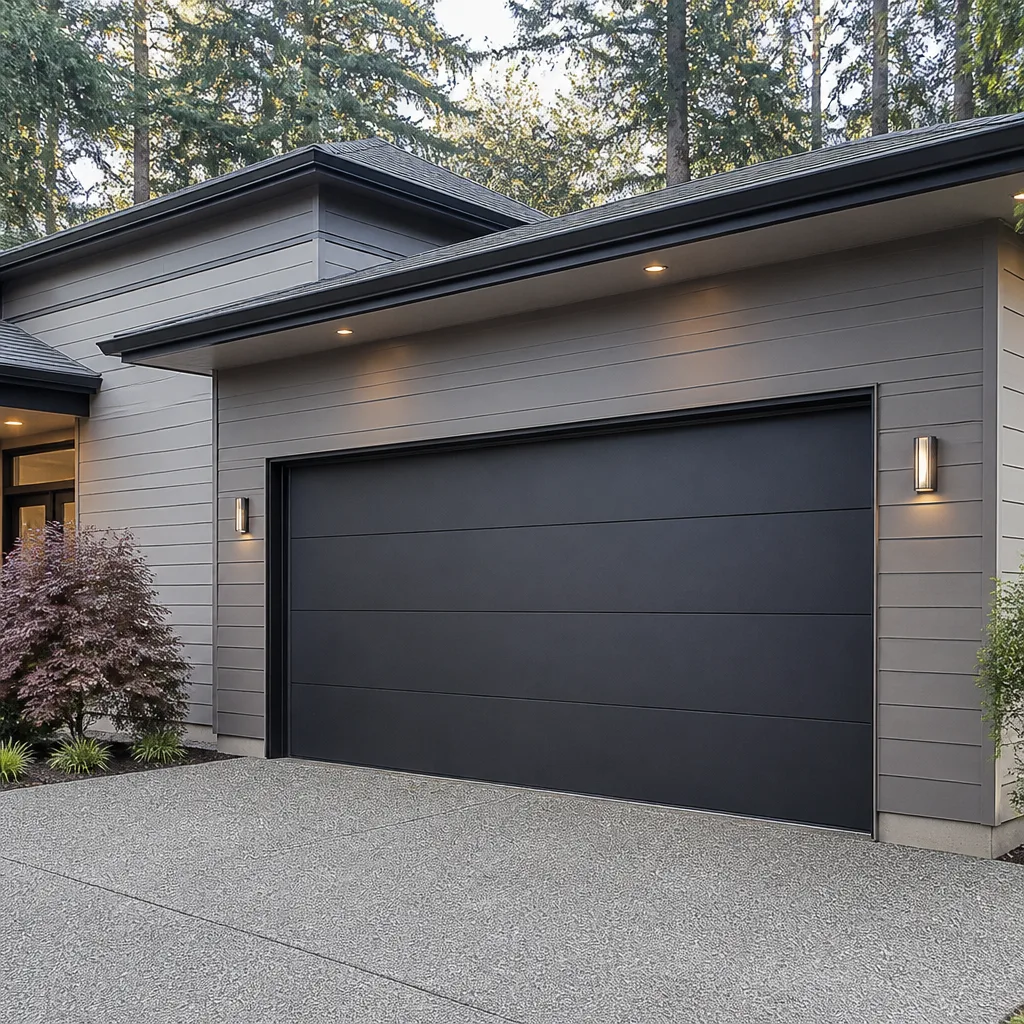 Modern flush
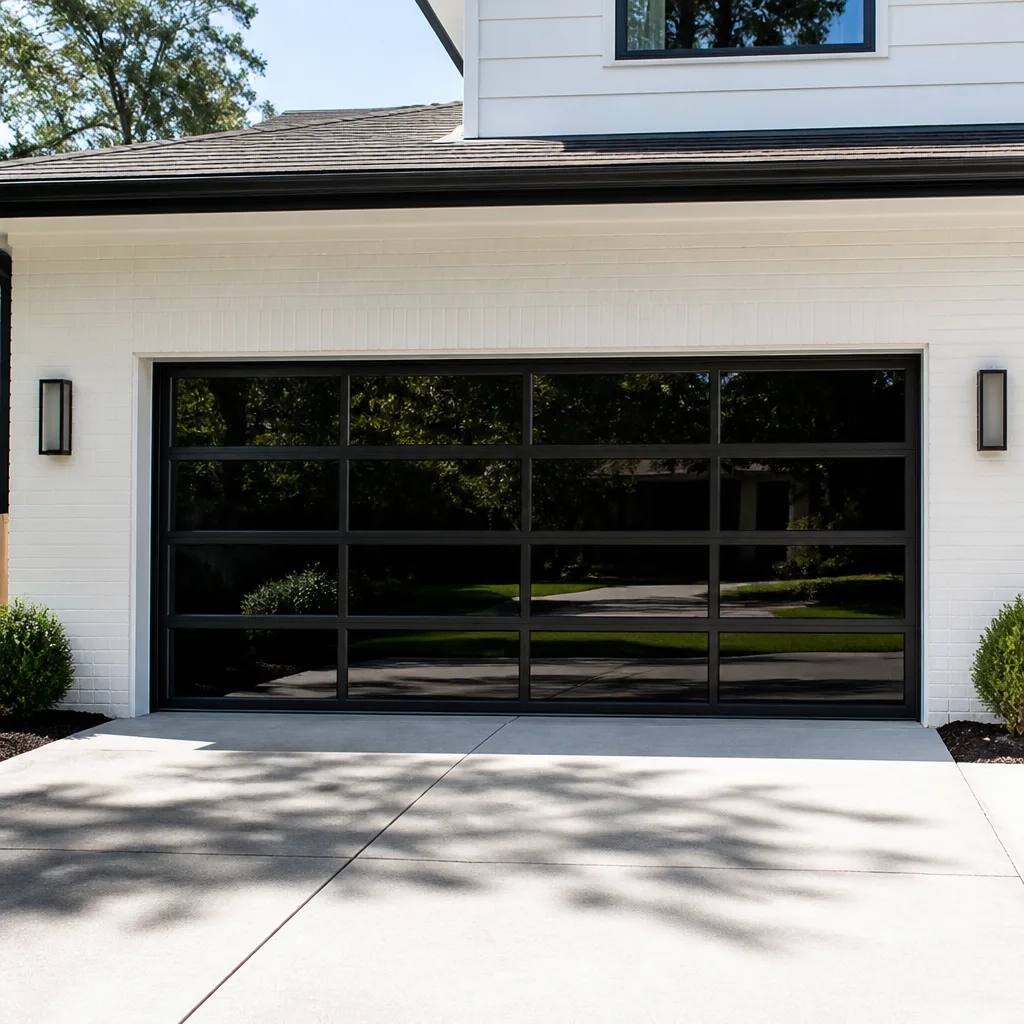 Full-view glass
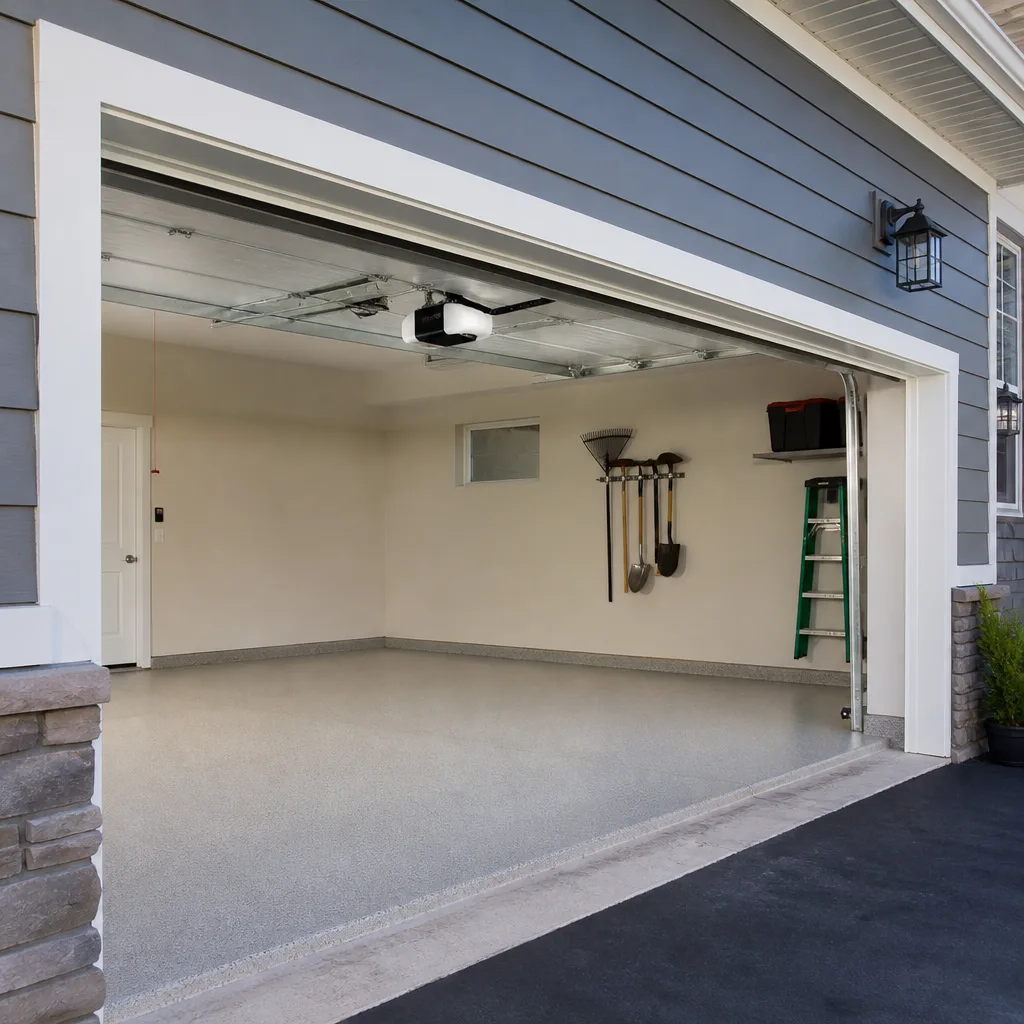 LiftMaster openers
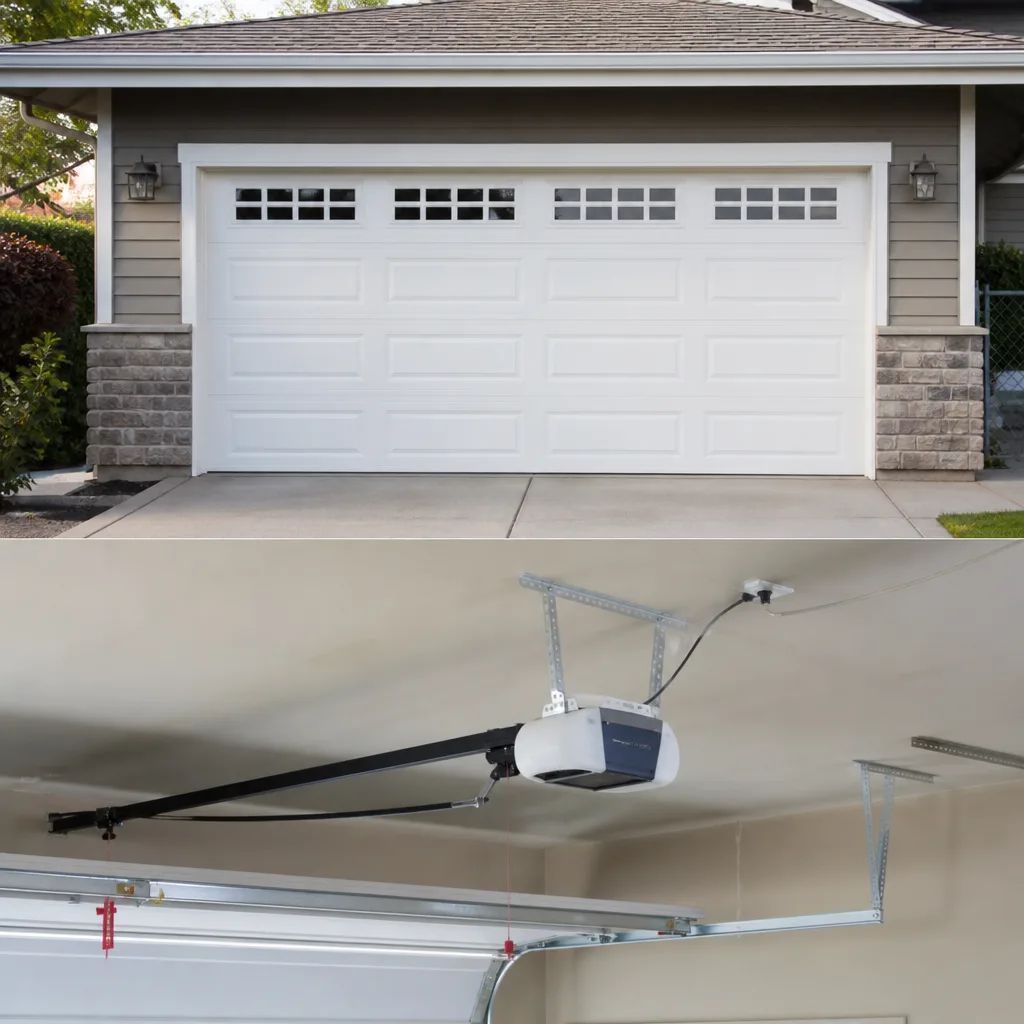 Chamberlain openers
Full 25-point door and opener safety check with every visit - springs, cables, rollers, tracks, and your LiftMaster or Chamberlain opener included
You get a price before we start. It does not change when the truck arrives.
Get your free estimateThe Complete Guide to Garage Door in Anaheim
The average Anaheim garage door system contains 11 moving components. Most homeowners can name maybe two of them: the door itself and the opener. That knowledge gap is exactly why a $40 roller replacement becomes a $400 emergency call, or why a $12 sensor alignment turns into a weekend without a parking space. This guide maps the entire ecosystem inside your Anaheim garage: the door, the springs, the track, the opener, and every connection point between them. For more guides & resources, visit our blog. By the time you finish reading, you’ll be able to identify your exact configuration, speak the language of the trade, and make a repair-or-replace decision without guessing.
Styles & brands we work with
Quick Answer
A garage door system in Anaheim has four integrated parts: the door panel assembly, the torsion or extension springs, the track and rollers, and the opener unit with its safety sensors. Most “broken door” calls are actually spring failures or opener logic issues, not door damage. Knowing which system you have before calling means faster diagnosis, correct parts on the first truck roll, and a repair bill that matches the actual problem.
Table of Contents
- The Anatomy of a Garage Door System: What’s Actually in Your Garage
- How to Identify Your Door Type, Track Configuration, and Opener Model
- What’s Installed in Anaheim Homes: 1960s Tracts to Newer Builds
- Door Problem, Spring Problem, or Opener Problem: Why the Difference Matters
- What a Healthy System Looks Like: Inspection Points That Matter
- Repair vs. Replace: When to Extend System Life and When to Stop Paying
- Opener Technology in Anaheim: From Chain Drive to Smart Home Integration
- Common Mistakes to Avoid
- When to Call a Professional
- Frequently Asked Questions
- The Bottom Line
The Anatomy of a Garage Door System: What’s Actually in Your Garage
When we walk into an Anaheim garage for a service call, we look at four things before touching anything. Here’s what’s up there, what it does, and what happens when it fails.
The Door Panel Assembly
Your door is not one solid piece. It’s a series of horizontal panels hinged together, typically steel, aluminum, or wood composite in Anaheim homes. Each panel runs on rollers that sit inside a track. The bottom panel carries the weather seal, which in Anaheim’s dry climate tends to crack from heat exposure long before it wears out from moisture. Panel damage usually comes from impact: a bike pedal that caught the edge, a car bumper that kissed the bottom panel, or a ladder that shifted against the face. The door also carries the struts, which are horizontal reinforcement bars across the top and sometimes bottom panels. Those struts distribute spring tension evenly. When a strut loosens, the door flexes unevenly and starts binding in the track.
The Springs: Torsion vs. Extension
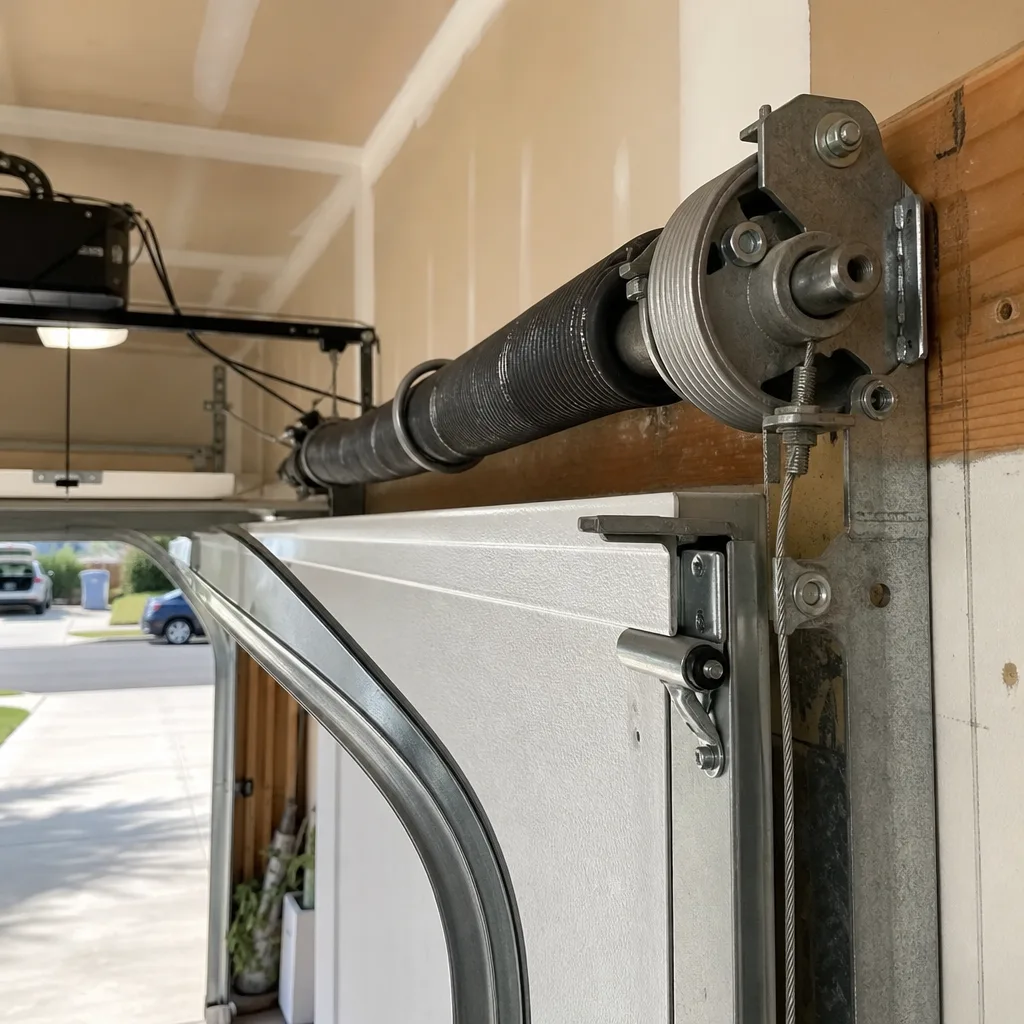
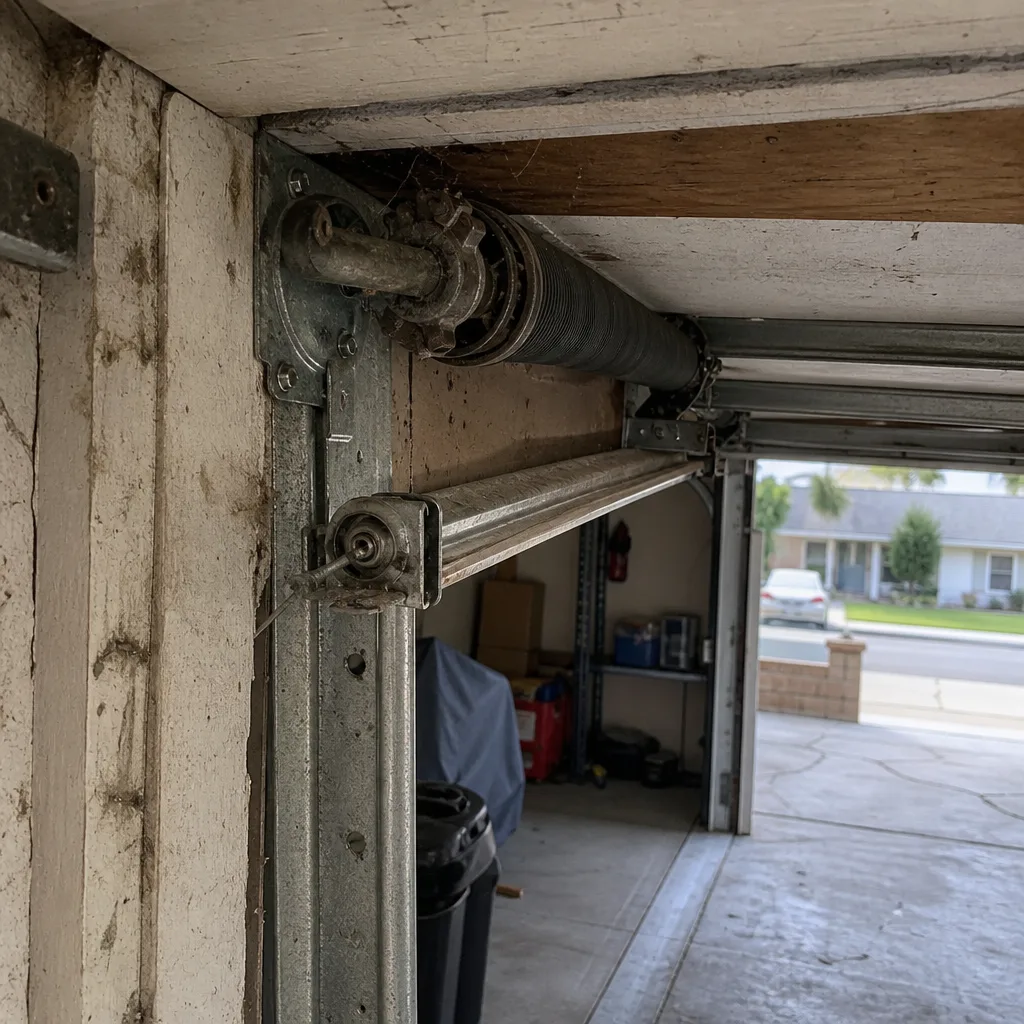
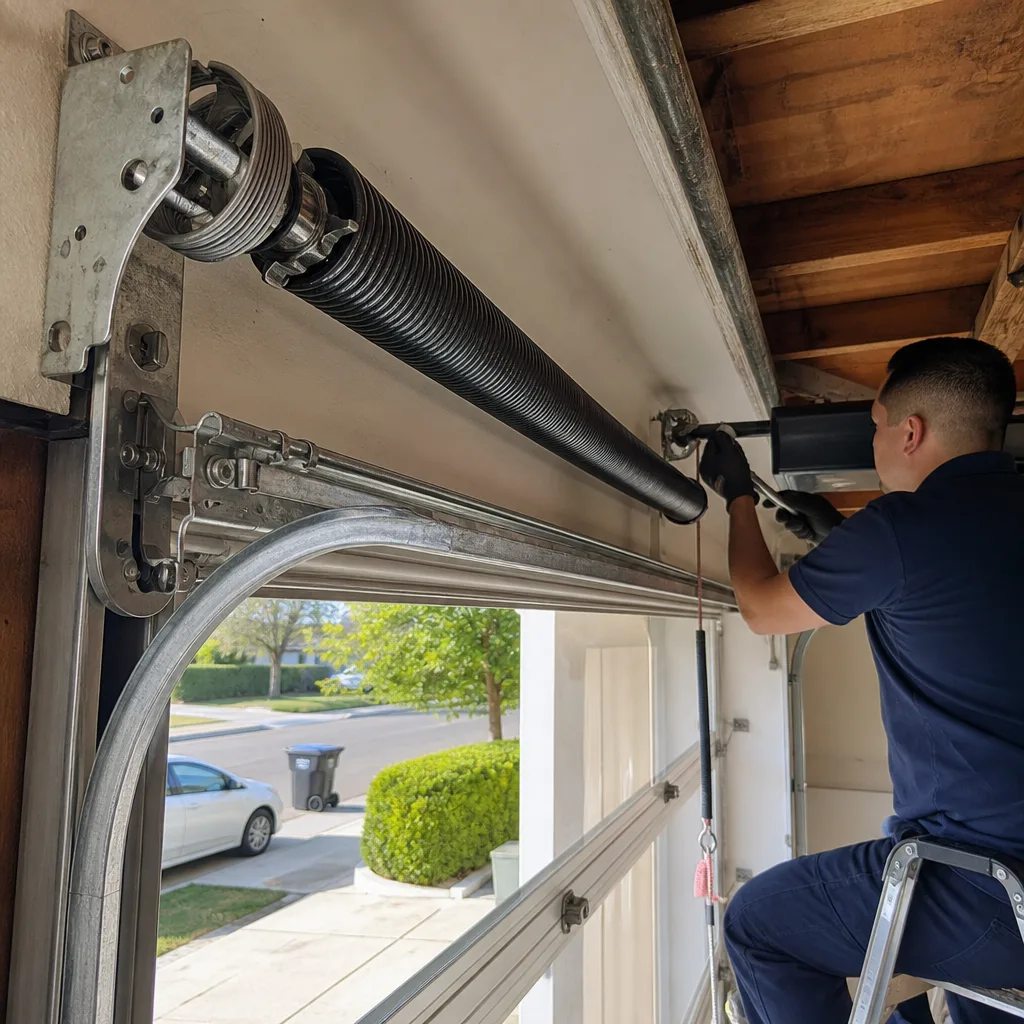
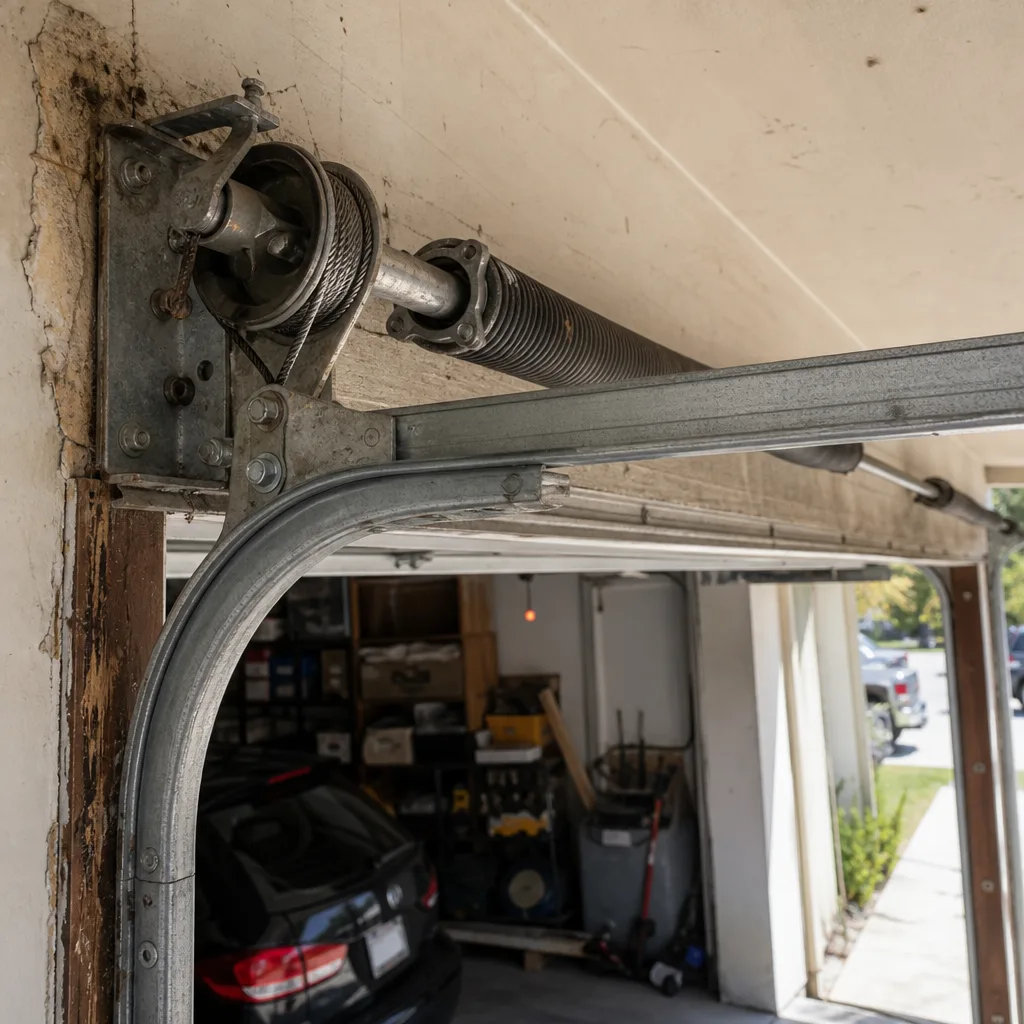
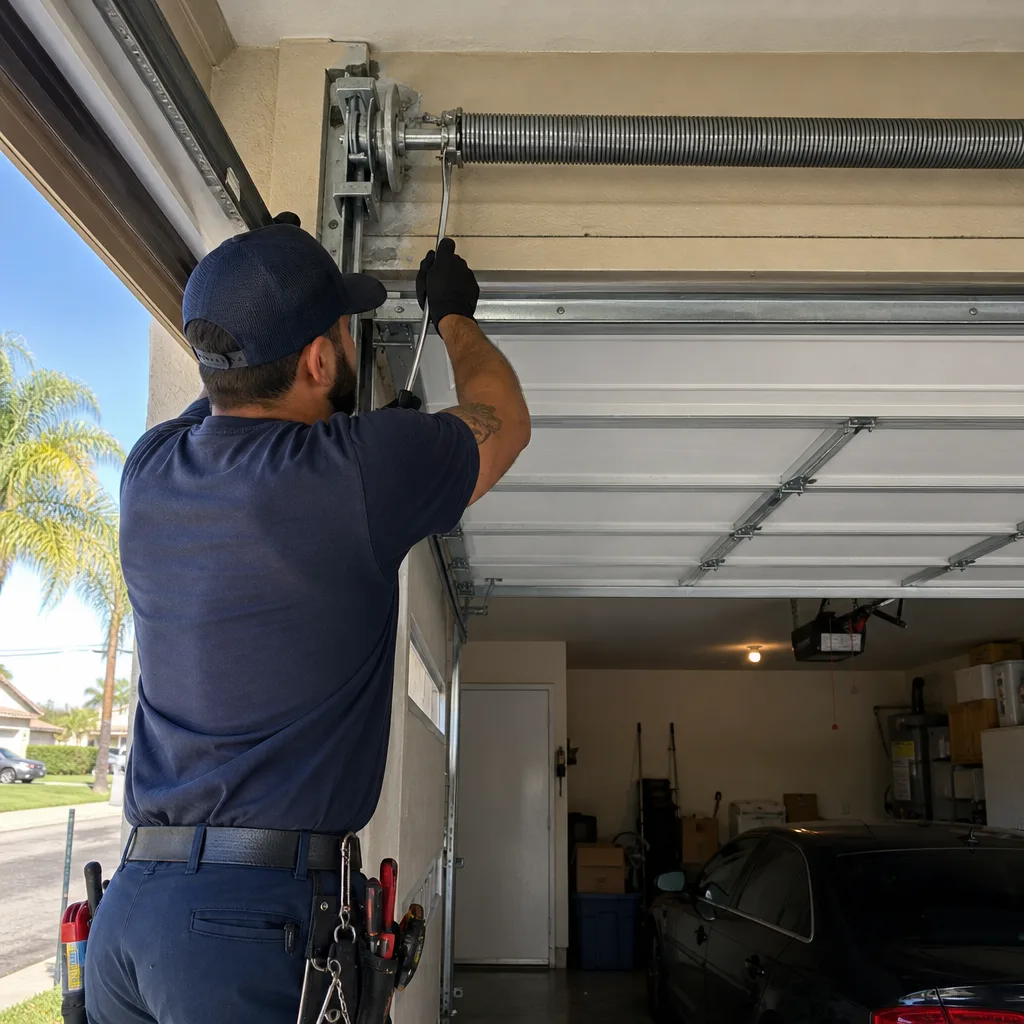
Springs do the heavy lifting. Literally. A standard 16-foot steel door in Anaheim weighs between 150 and 250 pounds. The opener motor only guides it; the springs counterbalance the weight. There are two configurations you’ll find locally. Torsion springs mount on a shaft above the door opening, running horizontally. Extension springs run alongside the track, above each horizontal rail. Torsion springs are standard on doors built since the late 1980s and are what we see on most Anaheim homes. Extension springs are more common on older 1960s-era builds. Both spring types are under extreme tension and have a rated cycle count. When a spring snaps, it sounds like a firecracker inside the garage. That sound is the #1 emergency call we get from Anaheim homeowners.
The Track and Rollers
Track is the steel channel that guides the door from vertical to horizontal. It comes in standard lift, high lift, and vertical lift configurations, though standard lift covers the vast majority of Anaheim residential installs. Rollers ride inside the track. Original equipment rollers on many Anaheim doors are steel with unsealed ball bearings. Those get loud, then they bind, then they fail. Nylon rollers with sealed bearings run quieter and last longer in Anaheim’s dusty conditions, which is worth knowing when you replace them.
The Opener Unit and Safety System
The opener is the motorized head unit mounted to the ceiling, connected to the door by a rail: chain, belt, or screw drive. Since federal law mandated safety sensors in 1993, every opener in Anaheim should have a photo eye pair mounted about six inches off the floor on each door jamb. Those sensors project an invisible beam. If anything breaks the beam while the door is closing, the door reverses. A surprising number of “broken” Anaheim openers are actually sensor pairs that got knocked out of alignment by yard tools or a passing bicycle.
How to Identify Your Door Type, Track Configuration, and Opener Model
Before you call anyone, gather three pieces of information. This takes five minutes and it changes the conversation from “my garage door is broken” to “I have a 7-foot Wayne Dalton steel door with a torsion spring and a belt-drive LiftMaster opener.” That specificity gets you the right parts and the right tech.
Step 1: Identify the Door Material and Brand
- Look at the inside face of the bottom panel while the door is closed. Many manufacturers stamp a sticker with the model number there.
- If the sticker is gone, check the hinges and the bottom brackets for a nameplate. Clopay, Amarr, Wayne Dalton, and Raynor all mark their hardware differently.
- Note the material: steel, aluminum, or wood composite. Each has different weight, spring sizing, and repair implications.
- Measure the door width and height. Standard Anaheim single doors are 8×7 or 9×7 feet. Double doors typically run 16×7 feet.
Step 2: Identify the Spring Configuration
- Stand inside the garage and look above the closed door. If you see a horizontal shaft with two coiled springs on it, that’s a torsion system.
- If you see two long springs running parallel to the track on both sides, that’s an extension system.
- Count the springs. A single torsion spring on a double door means the original installer cut a corner, and the remaining spring is carrying double the intended load.
Step 3: Identify the Opener
- Look at the motor housing on the ceiling. The brand is printed on the side: LiftMaster, Chamberlain, Genie, Raynor, Craftsman.
- Note the drive type. A chain rail has a visible metal chain. A belt rail has a rubber-reinforced belt. A screw rail has a threaded rod.
- Look for a learn button or a model sticker. LiftMaster and Chamberlain units have a color-coded learn button on the back or side of the motor head. That color tells the tech which remote frequency and logic board revision you have.
- Test the wall console. If it has a digital display, you have a newer smart-compatible unit. If it’s a simple push button, it’s a legacy opener.
Write these details down or take photos. When you call a garage door company in Anaheim, that information lets us arrive with the correct spring, roller, or logic board on the truck instead of making a second trip.
What’s Installed in Anaheim Homes: 1960s Tracts to Newer Builds
Anaheim’s housing stock lays out in distinct waves, and each wave has its own typical garage door profile. Knowing which wave your home falls into tells you what to expect and what failures are likely.
The 1960s – 1970s Tracts
Homes built during Anaheim’s post-war expansion and early suburban boom often still have their original wood or fiberglass doors. If a door from this era hasn’t been replaced, it’s a single-panel tilt-up or a wood sectional with extension springs. These doors are heavy by modern standards, and the extension spring systems are aging past their design life. The track hardware on these homes is often original too, which means loose brackets, worn rollers, and rail sections that are no longer true. Many of these doors have outlived their service life two or three times over. When we see an original 1972 door with a 2020 opener bolted to it, the repair conversation is already leaning toward replacement.
The 1980s – 1990s Boom
This era brought the first wave of steel sectional doors to Anaheim at scale. Torsion spring systems became standard. Door brands from this period include Wayne Dalton, Raynor, and early Clopay models. The doors themselves are usually sound, but the hardware has 30 to 40 years of cycles on it. Common call-outs from these neighborhoods include spring failures, roller wear, and opener replacement when the original chain-drive units finally give out. The good news: the door panels are almost always worth keeping, which makes repair cost-effective.
2000s to Present: New Construction and Renovations
Newer Anaheim builds and renovated properties typically have insulated steel doors with torsion springs, nylon rollers, and belt-drive smart openers. Brands like LiftMaster and Chamberlain dominate the opener market in these homes, with Amarr and Clopay well-represented on the door side. These systems are quieter, lighter, and more efficient than their predecessors. The common failure points are different too: logic board issues, sensor misalignment, remote programming conflicts, and the occasional spring that breaks before its rated cycle count due to a manufacturer defect.
If you’re not sure which era your home falls into, look at the door itself. Original wood or single-panel steel says early build. A steel sectional with a torsion shaft says 1980s or later. An insulated door with a smart opener says 2000s or newer.
Door Problem, Spring Problem, or Opener Problem: Why the Difference Matters
This is the mistake that costs Anaheim homeowners real money. They call and say, “My garage door is broken.” Then a tech arrives, diagnoses a snapped spring, and the customer is surprised that the door itself is fine. Or worse: a homeowner decides the opener is dead, buys a new unit, and the door still won’t move because the spring was the actual failure. Here’s how to tell the three apart before you make a call.
Door Problems
Door problems are physical issues with the panels, hinges, track, or rollers. You’ll see a visible dent, a bent track, a door that hangs crooked, or a panel that binds when it passes a specific point in the travel. The door might be noisy but will still move under opener power. Door problems are usually obvious if you look. A sagging panel, a torn weather seal, a hinge that’s pulling away from the panel face. These are mechanical wear-and-tear or impact issues.
Spring Problems
Spring failures show up as either a loud snap followed by a door that suddenly weighs 200 pounds, or a door that creeps down when you release it manually. You’ll also notice the door feels heavy when you try to lift it by hand. On an extension spring system, you’ll see a gap in the spring itself. On torsion systems, the spring has a visible separation where the coil broke. Either way, do not operate the door. The opener will strain against the full weight and can destroy its own gear assembly in minutes. Spring replacement is a repair we handle regularly, and it’s the component Anaheim homeowners should never attempt themselves. See our DIY vs Professional Garage Door: The Anaheim Homeowner’s Decision Guide for why. The tension involved is lethal if released incorrectly.
Opener Problems
Opener problems are electrical or logic issues. The motor runs but the door doesn’t move. The remote works intermittently. The wall console flashes error codes. The door reverses on its own. Or there’s no response at all. A quick test: pull the red manual release cord and try lifting the door by hand. If it moves easily and stays put, the springs and door are fine. The problem is in the opener. That test alone saves you from replacing a door when you need opener repair, which is a different service entirely. For a deeper look at this side of the system, see our garage door opener repair in Anaheim page.
What a Healthy System Looks Like: Inspection Points That Matter
A complete garage door inspection covers specific checkpoints. We do this dozens of times a week across Anaheim, and homeowners can learn what to look for themselves. Here’s the list, from top to bottom.
- Springs: Both torsion springs should be intact with no visible gaps in the coil. Extension springs should have safety cables running through them, which is code in most jurisdictions. Any rust, separation, or uneven stretch is a red flag.
- Cables: The lift cables on both sides of the door should be taut and seated correctly on the drum. A slack cable or a frayed section means imminent failure.
- Rollers: All rollers should spin freely. A roller that slides instead of rolls is chewing up the track. Look for flat spots and missing bearings.
- Track: Both vertical and horizontal track sections should be straight, securely bolted, and free of gaps at the joints. A bent track can cause the door to bind or derail.
- Hinges: All hinge screws should be tight. A loose hinge at the bottom panel is common and causes the panel to crack around the hinge point.
- Weather seal: The bottom seal should make full contact with the floor. In Anaheim’s heat, rubber seals bake, crack, and lose flexibility, letting dust, debris, and warm air into the garage.
- Opener: The opener rail should be lubricated, the unit should respond to both remote and wall console, and the safety sensors should be aligned and clean. The auto-reverse function should stop the door on contact with an object. That test takes 10 seconds and every owner should do it monthly.
- Balance: Release the opener and manually lift the door to waist height. A balanced door stays in place. A door that drops or rises needs spring adjustment. This is the single most informative test in garage door maintenance.
In our experience, Anaheim homeowners who run through this checklist twice a year catch 80% of developing problems before they become emergency calls. The other 20% are spring failures, which happen without warning regardless of maintenance.
Repair vs. Replace: When to Extend System Life and When to Stop Paying
This is the question we answer honestly every week. The answer depends on the condition of the door itself, not the age of the opener or how many times it’s broken this year. Our Garage Door Cost Breakdown: The Anaheim Homeowner’s Reference for 2026 can help you budget accordingly. Here’s the decision framework we use when we walk an Anaheim customer through their options.
Repair Makes Sense When
- The door panels are straight, rust-free, and structurally sound. Steel sectional doors from the 1990s and later are often in excellent shape after 30 years in Anaheim’s dry climate.
- The spring failure is the first one the door has had. A replacement pair of torsion springs rated for 10,000 cycles will typically last 10-15 years for a one-car household.
- The opener issue is isolated: a sensor, a logic board, a gear assembly, or a remote programming conflict. These are component-level fixes that extend opener life by years.
- The track and hardware are intact and the door balances correctly after spring replacement.
Replacement Makes Sense When
- Multiple panels are dented or damaged, especially the bottom panel, which carries the most stress.
- The door is original to a 1960s or 1970s home and has no insulation, sagging wood panels, or fiberglass that’s cracking through.
- You’ve replaced springs, rollers, and hinges in the last three years and something new keeps failing. That’s a system reaching the end of its service life, not a component problem.
- You want modern insulation, a quieter door, or a smart opener system and your current door can’t support the upgrade.
The honest answer is usually a judgment call. A door that needs its second spring replacement with a 1978 single-panel design behind it is not worth spending another $300 on. A 2005 steel door with a failed opener is absolutely worth keeping. We tell customers both things, and we don’t upsell replacements when a repair is the right call. That’s what the garage door repair in Anaheim side of our business is built on.
Opener Technology in Anaheim: From Chain Drive to Smart Home Integration
The opener market has shifted dramatically in the last 15 years, and Anaheim homes have openers from every generation. Understanding what you have and what’s available helps you make a coherent decision, especially if you’re pairing a new opener with an existing door.
The Three Drive Types
Chain drive is the original workhorse. It’s loud, reliable, and inexpensive. Millions of these are still running in Anaheim garages, especially in 1990s and early 2000s builds. If your garage is detached or you don’t have living space above it, a chain drive works fine. Belt drive is the quiet upgrade. A reinforced rubber belt replaces the chain, cutting noise significantly. Belt drives are the default choice for attached garages with bedrooms nearby. Screw drive units, once common with Genie models, use a threaded rod and have fewer moving parts. They’re fast but can be noisy in cold weather, which is less of a concern in Anaheim than in other markets.
Smart Openers and Integration
Modern LiftMaster and Chamberlain openers feature built-in Wi-Fi, letting you open or close the door from your phone, check open/closed status, and set up alerts. These integrate with MyQ, which is the platform both brands share. Other systems in your home, from security cameras to smart speakers, can often tie into the opener. If you have a newer unit with a color-coded learn button and a round LED, you likely already have smart capability. Older openers can sometimes be upgraded with a smart hub, but the cleaner solution is often a new opener head unit paired with your existing rail and door, which keeps installation straightforward.
When an Anaheim customer calls us about opener replacement, we ask about the door first, then the drive type, then the smart features they actually want. Not everyone needs Wi-Fi. But almost everyone in a bedroom-over-garage floorplan wants belt drive. For a full breakdown of opener-specific issues, head over to our garage door opener repair page.
Common Mistakes to Avoid
- Misdiagnosing the failure. Assuming the opener is dead when the spring is broken leads to replacing a working opener while the door still won’t move. Test the manual operation first.
- Attempting DIY spring replacement. Torsion springs hold enough tension to cause fatal injury. This is not a weekend project in an Anaheim garage. Hire a professional.
- Ignoring the safety reversal test. Every opener with auto-reverse should be tested monthly by placing a 2×4 on the floor under the closing door. If it doesn’t reverse, disengage the opener until it’s fixed.
- Lubricating the wrong parts. Spraying the track or the rollers does nothing and makes a mess. The spring, hinges, and roller bearings are what need lubrication, using a silicone or lithium spray.
- Replacing the door when the opener needs work. We see Anaheim homeowners quoted for a full door replacement when the actual issue is a $40 logic board or a $20 sensor pair. Get a diagnosis before you write a check.
- Mixing components without checking compatibility. A new smart opener bolted onto a 1975 door with failing springs and loose track will not fix the underlying system problems. The system has to work as a whole.
- Skipping the quote-before-work agreement. Never approve work without a written price in hand. A reputable Anaheim garage door company quotes the job before anything starts, and that’s the standard we hold at Porter Garage Door.
When to Call a Professional
Some garage door work is genuinely dangerous. Spring replacement, cable replacement, and track realignment all involve components under load, and a mistake can cause serious injury or significant property damage. If you hear a snap, if the door hangs crooked, if the cables are frayed, or if the door drops when released, stop using the door and call a specialist. Opener electrical issues are also best left to someone doing this work daily, especially on newer units with logic boards and smart home wiring. The same goes for any door you’re not confident about identifying. Porter Garage Door offers free estimates in Anaheim. We’ll diagnose what’s actually wrong, tell you plainly whether repair or replacement makes sense, and quote the work before we start it. Call (833) 589-5745.
Frequently Asked Questions
Spring replacement in Anaheim typically runs $180 to $340 depending on the spring size, door weight, and whether you need one spring or a matched pair. We always recommend replacing both springs at once even if only one snapped, since they share the same cycle count. Call (833) 589-5745 for an exact quote. Estimates are free.
Yes, in most Anaheim service areas we can have a technician at your door the same day for spring failures, doors stuck open, and other emergency situations. We answer calls and dispatch for emergencies, and the parts for common brands like LiftMaster, Chamberlain, and Genie are already on our trucks. See our Garage Door Emergency Preparedness Guide for Anaheim Homes to plan ahead.
We work on all eight major residential brands: LiftMaster, Chamberlain, Genie, Clopay, Amarr, Wayne Dalton, Craftsman, and Raynor. That means the brand already installed in your Anaheim garage is a brand our technicians know, with the right parts on hand or quickly sourced.
If the opener motor runs but the door doesn’t move, you’re likely looking at a broken gear, a stripped drive coupler, or a door that’s too heavy for the opener to lift because the springs failed. Pull the manual release and test the door by hand. If it’s heavy, the springs are the problem. If it moves easily, the opener needs repair.
Repair if the panels are straight and rust-free, the spring failure is recent, and the track is intact. Replace if the door has multiple damaged panels, sagging wood, or has consumed repeated repairs in a short window. A 20-year-old steel sectional with solid panels is usually worth keeping. A 1970s single-panel wood door is usually not.
Yes. Full garage door installation in Anaheim is one of our three core services, alongside repair and opener repair. We handle the full system: door, track, springs, and opener, sized to your opening and matched to the brand family you prefer.
The Bottom Line
Your Anaheim garage door is a mechanical system, not a magic box. It has identifiable parts, predictable failure points, and a lifecycle that runs from 15 to 40 years depending on the build quality and how well the springs, rollers, and track are maintained. Knowing your door type, spring configuration, and opener model before you call saves time, money, and the headache of a wrong diagnosis. When a repair is the right call, do it early. When the system has reached the end of its service life, replacing it with a properly matched door and opener is the smarter investment. Either way, work with a company that quotes before it starts and knows the brand already in your garage. That’s how we’ve built our reputation across Anaheim.
Written by the team at Porter Garage Door, serving Anaheim since 2015.
See the difference
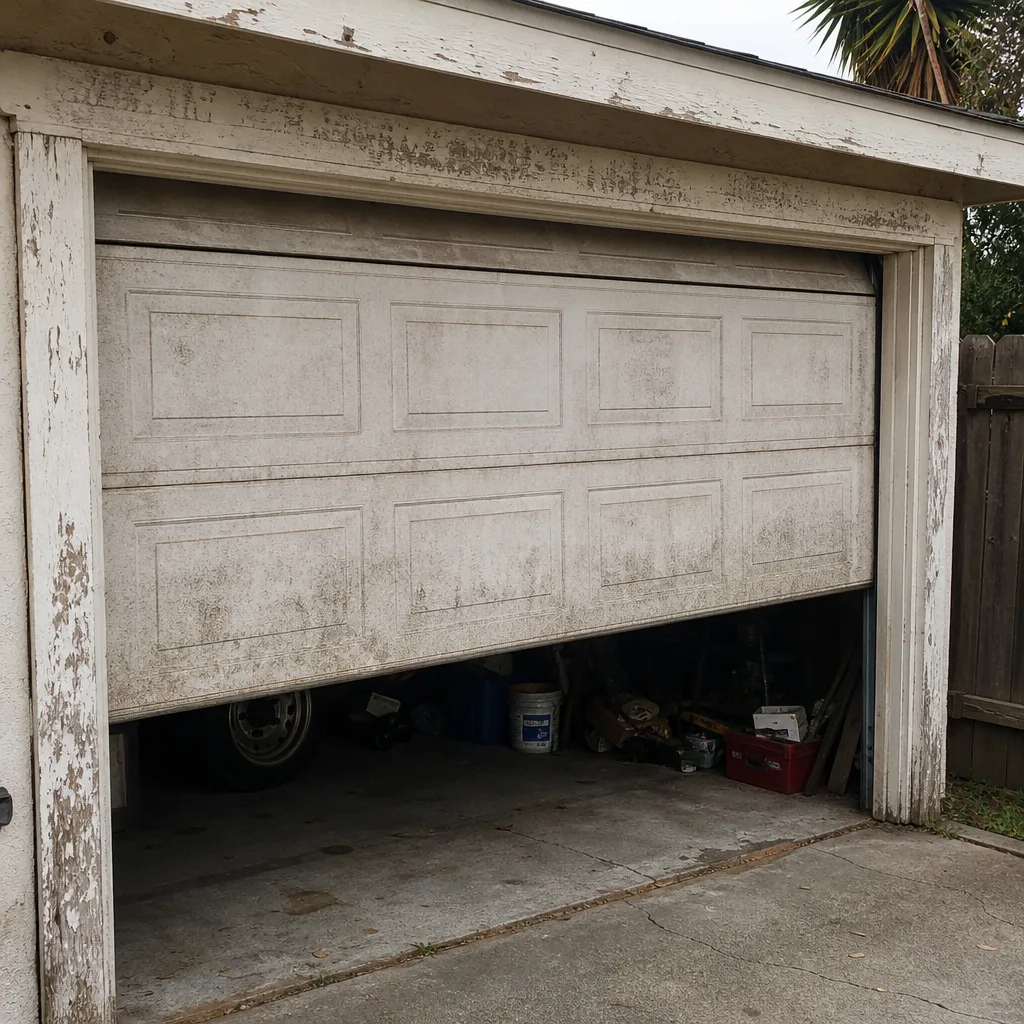 Before
 After
 Before
 After
 Before
 After